
A child's visual system develops rapidly in the first several years of life, and problems that go undetected during this window can become much harder to treat later. Early eye exams are one of the most effective tools we have for catching issues before they cause lasting harm. What looks like a behavioral or academic problem is sometimes a vision problem in disguise.
A large portion of what children absorb in the classroom comes through their eyes. When vision is unclear or the eyes are not working together properly, tasks like reading, writing, and copying from a board become significantly harder. Children who struggle to see clearly may fall behind academically even though they are fully capable learners.
Most children do not know their vision is poor because they have nothing to compare it to. Blurry or strained vision feels completely normal to them. This is one of the most important reasons routine eye exams are necessary, rather than waiting for your child to say something is wrong.
The brain learns how to process vision during the first several years of life. If one eye is not sending clear signals during this period, the brain can begin to ignore it permanently, a condition called amblyopia, or lazy eye. Treatment is most effective before age 7, when the visual system is still actively developing. After that window closes, progress becomes more limited.
Children with undetected vision problems are sometimes misidentified as having attention difficulties or learning disorders. When they avoid reading, seem distracted during close work, or struggle to stay on task, the root cause may simply be that seeing is physically difficult for them. Addressing the vision problem often leads to meaningful improvements in behavior and academic performance.
Clear, accurate vision supports more than schoolwork. Depth perception, peripheral vision, and the ability to track moving objects all play important roles in physical safety during sports, cycling, and everyday play. Eye exams assess these visual skills and give us the opportunity to correct any gaps before they lead to accidents or injury.
Eye care guidelines recommend specific checkpoints that align with the stages of your child's visual development. Following this schedule helps ensure that any problems are found when they are most responsive to treatment. Our team is experienced in working with children of all ages, from infants to teenagers.
The first comprehensive eye exam should happen between 6 and 12 months of age. During this visit, our doctors check that both eyes are developing properly, assess how well the eyes move and focus together, and look for early signs of eye disease. The exam is completely painless and uses techniques designed specifically for babies, including methods that do not require any verbal response from your child.
The next exam should occur around age 3, or earlier if you have any concerns. At this stage, our doctors can begin testing how the eyes work together and screen for early signs of nearsightedness, farsightedness, and lazy eye. Eye charts featuring pictures instead of letters make the exam accessible and even enjoyable for young children. Many conditions at this age show no outward signs, so routine exams remain the most reliable way to catch them.
Every child should have a complete eye exam before starting school. This visit focuses on detecting anything that could interfere with learning to read or write, including focusing problems, eye coordination issues, and significant prescriptions. Catching these issues before kindergarten gives your child the best possible start. Research suggests that roughly 5 to 10 percent of preschool-age children have vision problems that need attention.
Once your child starts school, annual eye exams are generally recommended, or every two years if there are no active problems. Nearsightedness (blurry distance vision) tends to develop and progress during the school years, and regular exams allow us to update prescriptions as your child grows. School screenings are a helpful first step but are not a substitute for a comprehensive exam, as they miss many important conditions.
Some children benefit from earlier and more frequent exams based on their individual situation. Our team may recommend a different schedule if any of the following apply to your child.
Your doctor will work with you to create a schedule based on your child's specific risk factors and history.
In between scheduled visits, there are warning signs that can tell you something may be wrong with your child's vision. Catching these signs early allows us to address problems before they become harder to treat. Do not wait for the next routine visit if you notice any of the following.
Frequent squinting, particularly in bright light or when looking at distant objects, often signals a vision problem. Covering one eye, excessive blinking, or rubbing the eyes frequently may indicate strain or discomfort. Eyes that appear red, watery, or crusty without explanation may point to allergies, infection, or other issues. A white spot visible in the pupil or eyes that do not appear straight are serious signs that warrant prompt attention.
Children with vision problems often compensate in ways that are easy to spot once you know what to look for. Sitting very close to the television, holding books unusually close, or tilting the head when reading are common signs. Some children avoid activities that require clear vision, like sports or detailed close work, or become clumsier than expected for their age. Stumbling, bumping into objects, or struggling with stairs may also suggest visual difficulties.
Take note when your child mentions headaches, especially after reading, doing homework, or spending time on a screen. Comments about tired eyes, blurry words, words that seem to move on the page, or seeing double are all signals that something may be off. These symptoms often worsen as the day goes on and the eyes become more fatigued from compensating for an underlying problem.
If eye conditions run in your family, your child has an elevated chance of developing similar issues. A family history of nearsightedness, lazy eye, crossed eyes, glaucoma, or other eye diseases is an important reason to begin exams earlier and maintain a more frequent schedule. Let us know about your family's eye health history at your child's first visit so we can plan accordingly.
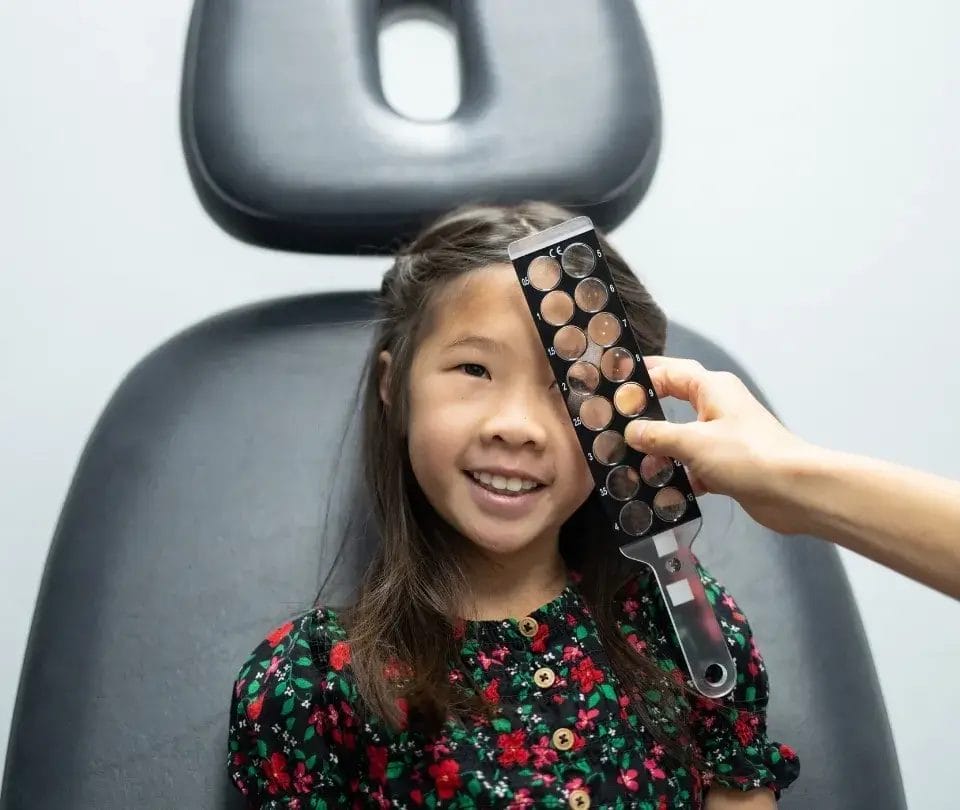
Children's eye exams are designed to be comfortable, engaging, and age-appropriate. Understanding what happens during a visit can help both you and your child feel at ease. Our team takes extra care to make every young patient feel welcome and safe throughout the appointment.
Our doctor will begin by reviewing your child's health history and asking about any concerns you have noticed at home or school. Vision is then tested using age-appropriate methods, including picture charts for younger children and standard charts for older ones. The doctor will also assess how well the eyes move, how they work together, and the overall health of the eye structures both inside and out. Most exams take between 30 and 45 minutes and involve no pain of any kind.
We use specialized equipment designed for young patients, including handheld instruments and colorful targets that hold a child's attention. For infants and very young children, our doctors use techniques that require no verbal response, allowing us to assess vision objectively. In some cases, we may use safe dilating eye drops to get a clearer view inside the eye. These drops temporarily blur close vision but do not cause pain or lasting effects.
Before the visit, talk with your child about what will happen using simple, positive language. Let them know the doctor will play some easy games to check how well their eyes work, and that nothing will hurt. Scheduling the appointment when your child is well-rested and not hungry can make a meaningful difference in how smoothly the exam goes. Bring any current glasses or contact lenses, and feel free to bring a comfort item from home.
When a vision problem is identified, our doctors take time to explain the findings clearly, using language that both you and your child can understand. Treatment might include glasses, contact lenses, patching therapy, or other approaches depending on the condition. Most childhood vision problems respond well to treatment, particularly when they are caught early. You will leave with a clear plan, and follow-up visits allow us to monitor progress and adjust treatment as needed.
Several eye conditions appear frequently in childhood, and most of them are very treatable when identified at the right time. Knowing what these conditions are can help you recognize potential signs and feel more confident about treatment options. Our team has extensive experience diagnosing and managing all of these conditions in children.
Amblyopia occurs when one eye does not develop normal vision, causing the brain to increasingly rely on the stronger eye. It affects roughly 2 to 3 percent of children and often shows no visible symptoms. Treatment typically begins with glasses to correct any prescription difference, followed by patching the stronger eye or using special drops to encourage the brain to engage the weaker one. Results are best when treatment starts before age 7, though older children can still make meaningful progress.
Strabismus is a condition in which the eyes do not point in the same direction, which can cause double vision and poor depth perception, and may lead to amblyopia if left untreated. Treatment depends on the underlying cause and may include glasses, eye exercises, or surgery to rebalance the eye muscles. Many children achieve excellent outcomes with appropriate care, allowing both eyes to function together as a team.
Refractive errors include nearsightedness (blurry vision at a distance), farsightedness (difficulty focusing up close), and astigmatism (blurred vision at most distances due to irregular eye shape). These are the most common reason children need glasses, affecting roughly one in four school-age children. Glasses are the standard first treatment, and for older children, contact lenses may also be appropriate. Myopia control treatments can help slow the progression of nearsightedness in eligible children.
Some children have difficulty sustaining clear focus or coordinating their two eyes properly, even without a prescription need. These conditions, sometimes called accommodative or binocular vision disorders, can cause eyestrain, headaches, and reading difficulties that closely resemble learning problems. Treatment is tailored to each child and often includes specific exercises or vision therapy, which involves guided activities that train the eyes and brain to work together more efficiently.
Less commonly, children can develop conditions such as pediatric glaucoma, congenital cataracts (clouding of the lens present from birth), retinal disorders, or eye infections that require timely diagnosis and specialist involvement. Our doctors screen for these during routine exams and coordinate appropriate referrals when needed. Early identification and treatment are essential for protecting your child's vision in these cases.
These questions address common decision points and situations that parents often face when navigating their child's eye care for the first time.
School screenings are a useful first step, but they are limited in scope, typically testing only basic distance vision. They frequently miss conditions like focusing problems, poor eye coordination, farsightedness, and early eye disease. If a screening raises a concern, that is a prompt to schedule a full exam rather than a replacement for one. Think of the screening as a starting point, not a clearance.
Screens have not been shown to cause permanent eye damage, but extended near-focus activity can contribute to digital eye strain and may play a role in the development or worsening of nearsightedness. Encouraging daily outdoor time, at least one to two hours, has been shown to have a protective effect on eye growth. The 20-20-20 rule (every 20 minutes, look at something 20 feet away for 20 seconds) is a practical habit that reduces strain during screen use. If your child regularly complains of headaches or tired eyes after screen time, an exam is a good next step.
Anxiety about new experiences is entirely normal, and our team is experienced in working with children who feel nervous or unsure. Reading a simple book about eye exams together beforehand and role-playing what might happen at home can reduce uncertainty. Reassuring your child that there are no needles and nothing that will hurt is important. Bringing a favorite toy and staying close during the exam helps many children feel safe and cooperative.
There is no fixed minimum age. Readiness for contact lenses depends more on a child's maturity and ability to follow care instructions than on age alone. Some children as young as 8 to 10 manage contact lenses very successfully, particularly if they are active in sports or have a high prescription that functions better with contacts. Our doctors will evaluate whether your child is ready and provide thorough training to ensure safe lens handling and hygiene.
Myopia control refers to treatments that are specifically designed to slow the rate at which nearsightedness progresses in children, rather than just correcting current blur. Options include specialty contact lenses, certain lens designs for glasses, and low-dose atropine eye drops used at bedtime. Not every child needs myopia control, but it may be a valuable option if your child's prescription is advancing quickly year over year. Our doctors can measure progression over time and help you decide whether this approach is appropriate.
Yes, this connection is more common than many parents expect. When a child cannot see clearly or comfortably, they may become frustrated, avoid visual tasks, seem distracted, or act out, all of which can look like behavioral or attention disorders. If your child has been assessed for behavioral or learning concerns, a comprehensive eye exam is an important part of the evaluation process. Correcting an underlying vision problem can sometimes produce noticeable improvements in focus, behavior, and engagement in school.
Your child's vision plays a central role in how they learn, grow, and experience the world around them, and our team is here to help protect it at every stage. At Insight Vision Optometry, Las Vegas, we bring advanced diagnostic tools and a genuinely caring approach to every pediatric visit. Whether your child is due for their first exam or you have noticed something that concerns you, we welcome you to schedule an appointment and experience the difference that expert, attentive eye care can make.


