Understanding how your eye responds to foreign material can help you react more calmly and make better decisions in the moment. The eye is designed to defend itself, but that defense has limits when particles are large, sharp, or firmly lodged.
When sand or dirt enters your eye, it typically lands on the cornea or becomes trapped under your upper or lower eyelid. The cornea is one of the most nerve-rich surfaces in the body, which is why even a tiny grain of sand can feel much larger than it actually is. Your eye immediately produces extra tears in an attempt to flush the irritant out.
When a particle is trapped under an eyelid, every blink drags it across the corneal surface. This repeated friction can create small scratches called corneal abrasions, which are painful but usually heal well with proper care.
Most people experience discomfort right away when something enters their eye. The intensity of symptoms depends on the size, shape, and location of the particle.
Some symptoms go beyond ordinary irritation and signal a more serious injury. If you notice any of the following, seek professional care right away rather than continuing to manage the situation at home.
While anyone can get sand or dirt in their eye, certain situations and environments carry a much higher risk. Knowing your risk level can help you take protective steps before an injury happens.
People who work outdoors or with power tools face the highest daily exposure to airborne particles. Construction workers, landscapers, farmers, and anyone who uses grinding or cutting equipment can encounter high-speed debris that enters the eye before there is any time to react.
Outdoor recreational activities such as trail running, mountain biking, and beach volleyball also increase exposure significantly. Athletes and outdoor enthusiasts often underestimate how much wind-blown debris they encounter during activity.
Your surroundings play a major role in how often your eyes are exposed to particles. Certain environments make foreign body injuries far more likely.
Contact lens wearers face an added complication because particles can become trapped between the lens and the cornea, concentrating irritation against the eye surface and increasing the risk of abrasion. If you wear contacts and feel something in your eye, remove the lens before rinsing whenever safely possible.
Children are also particularly vulnerable because they play close to the ground, frequently rub their eyes with dirty hands, and often do not recognize when to protect their eyes. Supervision and age-appropriate protective eyewear during outdoor play can reduce their risk significantly.

The actions you take in the first few minutes after sand or dirt enters your eye can make a meaningful difference in how quickly you recover. Staying calm and following the right steps helps you avoid turning a minor irritation into a more serious problem.
Your first instinct may be to rub your eye, but rubbing is one of the most harmful things you can do. It can grind the particle deeper into the corneal surface and worsen any scratching. Instead, try the following steps before anything else.
Gentle rinsing with clean water is often the most effective first step for removing a loose particle. Use room temperature or lukewarm water, never hot or ice cold. If you have sterile saline solution on hand, it is preferable to tap water because it is closer to the natural chemistry of your tears.
Lean over a sink or use a clean cup filled with water. Tilt your head so the affected eye is lower, and pour water gently from the inner corner to the outer corner. You can also hold your eye open under a slow, steady stream from a faucet. Rinse for at least 15 minutes if there is any possibility of chemical contamination. For plain sand or dirt, a few minutes of thorough rinsing is usually enough.
Some common instinctive responses can actually make your injury worse. Avoid these actions during your initial response to a foreign body in your eye.
Contact our office or seek immediate care if the particle does not come out after 15 to 20 minutes of rinsing, or if you still feel something in your eye even though you cannot see anything when you look in a mirror. That persistent sensation often means a particle is still present or that a corneal abrasion has formed.
Any injury involving metal particles, high-speed debris from power tools, or hammering metal warrants professional evaluation even if the particle appears to have come out. Metal can leave behind a rust ring in the cornea within hours, and this requires specialized removal to prevent lasting damage.

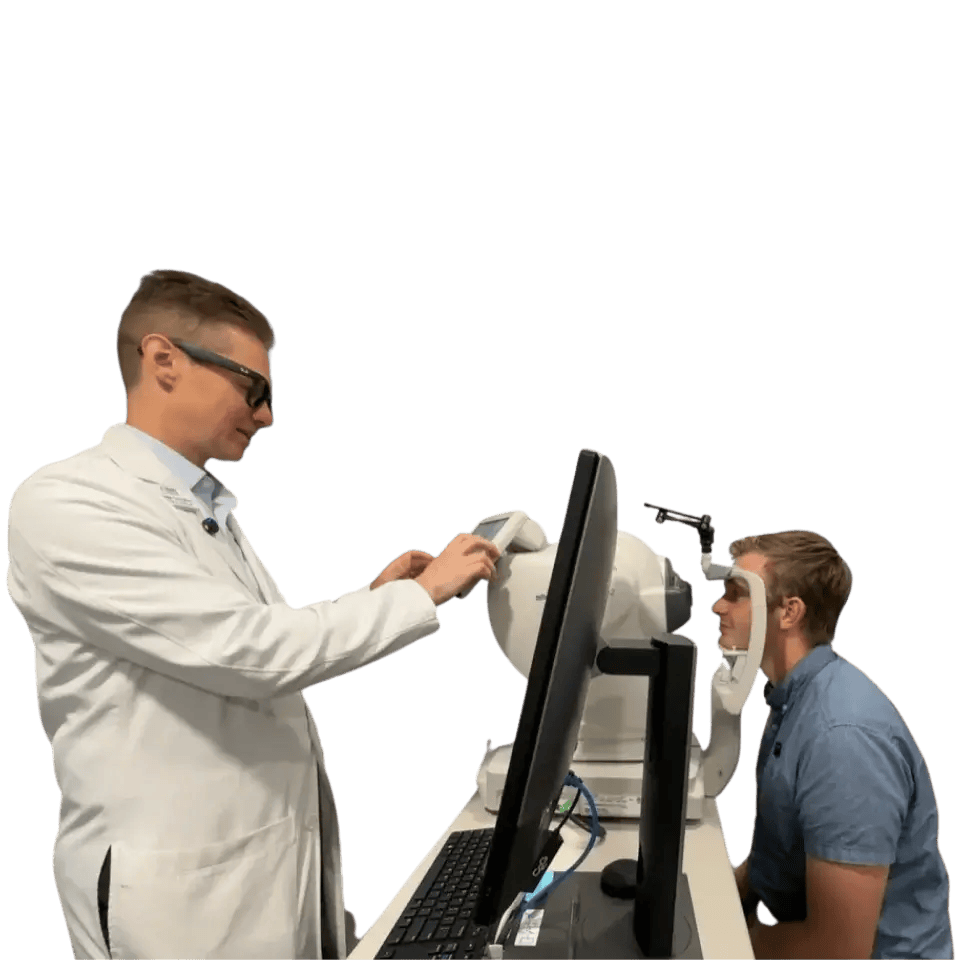
When you come in with a foreign body concern, we perform a thorough but efficient examination designed to find any remaining particles, assess for scratches, and determine the safest course of treatment. Our team has the specialized equipment needed to see what cannot be spotted with the naked eye.
We begin by asking you how the injury happened, what type of material entered your eye, and whether you were able to rinse it out. This information helps us determine the urgency of our response and what we are most likely to find. We examine both eyes even if only one feels affected, because particles can occasionally bounce from one eye to the other during the same incident.
We use a specialized microscope called a slit lamp to examine your eye at high magnification under a bright, focused light beam. This instrument allows us to inspect the cornea, the area under both eyelids, and the white of the eye in far greater detail than any standard exam allows. We may also gently flip your upper eyelid to check for debris hidden underneath.
A special orange dye called fluorescein is applied to your eye during the exam. Under blue light, this harmless dye glows bright green wherever the corneal surface has been scratched or damaged, making even microscopic abrasions clearly visible.
Most sand and dirt injuries affect only the superficial surface of the cornea, but we always check to make sure the particle has not penetrated into deeper tissue. We assess the depth and location of any damage we find and check your eye pressure as part of a complete evaluation. If there is any concern about a penetrating injury, particularly when the foreign body was traveling at high speed, we take additional steps to rule out internal damage before proceeding with treatment.
Treatment depends on what we find during your examination, including whether a particle is still present, how large any scratch is, and whether there are signs of early infection. Our goal is to relieve your discomfort quickly while protecting your eye during healing.
If a particle is still in your eye when you arrive, we remove it using the method that is safest for its location and how firmly it is stuck. Loose material on the eye surface can often be irrigated out with sterile saline. Particles adhered to the cornea or tucked under an eyelid are removed using fine instruments under magnification.
We always apply numbing drops before any removal procedure. The anesthetic takes effect within seconds, and you will not feel pain during the process. After removal, we rinse the eye thoroughly to ensure no small fragments remain.
Once the particle is out, we focus on preventing infection and supporting the natural repair process. If the particle left a scratch on your cornea, we typically prescribe antibiotic eye drops or ointment to guard against bacteria entering through the damaged tissue.
Corneal abrasions are scratches on the clear front surface of your eye. Fortunately, the cornea has a remarkable ability to heal on its own. Minor abrasions can often close within 24 to 48 hours, and most heal completely without any lasting effect on vision.
We do not routinely patch eyes for simple abrasions, as evidence shows that patching does not speed healing and may actually slow it. Instead, we recommend preservative-free artificial tears used frequently to keep the surface comfortable. For larger or more painful abrasions, we may fit a bandage contact lens, a soft lens worn temporarily to protect the healing cornea rather than to correct vision. Over-the-counter pain relievers by mouth can help manage discomfort during the first day or two.
Most sand and dirt injuries heal without complications, but some cases require more advanced care. We will refer you to a corneal specialist if a metal particle has left a rust ring in the cornea, if the foreign body has penetrated into deeper layers of the eye, or if the abrasion is very large or located directly over the center of your vision.
Any injury that shows signs of early infection, such as increasing redness, discharge, or worsening pain after initial treatment, requires close monitoring. We may schedule daily follow-up visits until we are confident that healing is progressing normally. Contact us right away if your symptoms worsen rather than improve after your initial visit.
Knowing what to expect during recovery helps you recognize normal healing versus a sign that something needs attention. Taking the right steps after treatment protects your eye and helps you avoid repeat injuries.
The first 24 hours are usually the most uncomfortable. You may continue to feel a sensation that something is still in your eye even after removal, because the abrasion itself stimulates the same nerve endings. This feeling should gradually improve as your corneal cells repair themselves.
We schedule follow-up appointments based on the severity of your injury. Minor cases may not need a return visit if you are feeling significantly better within a day or two. Moderate to large abrasions require a follow-up so we can confirm healing with another fluorescein dye exam and check for any signs of scarring or infection.
If you were fitted with a bandage contact lens, we will remove it once the epithelium, the outer protective layer of your cornea, has fully healed. Continue all prescribed medications for the complete course we recommend, even if your eye feels normal before you finish them.
Most foreign body injuries are preventable with the right protective measures. A single painful eye injury is often enough motivation to adopt better habits, and the steps involved are simple.
These questions address specific situations and decisions that patients often face after experiencing a foreign body injury.
You should not wear your regular contact lenses until we have confirmed that your eye has fully healed and cleared you to resume wear. Placing a lens over an abraded cornea can trap bacteria against the damaged surface and dramatically increase your infection risk. Depending on the size of the abrasion, you may need to avoid lenses for several days to more than a week. Wear your glasses during this period, and do not rush back to contacts before getting our approval.
The large majority of sand and dirt injuries heal without any lasting impact on vision. Superficial corneal abrasions typically close completely and leave no scar. The greater risks come from infections that develop after the injury or from particles that penetrate into deeper layers of the cornea. Scars that form in the central visual axis, directly in front of the pupil, have a greater potential to affect sight than those at the edge of the cornea. Prompt treatment and proper follow-up reduce these risks substantially.
If the scratchy sensation resolves completely after thorough rinsing at home and your vision remains clear, a visit may not be urgent. However, if the discomfort improved but did not fully resolve, if you ever felt something was stuck, or if you were using power tools or working with metal when the injury happened, you should still come in for an exam. Some particles remain embedded even when symptoms temporarily ease, and metal foreign bodies can begin to rust within hours of entering the eye, making early removal important.
Preservative-free artificial tears or plain lubricating drops are safe and genuinely helpful for keeping the eye comfortable during healing. What you should avoid are redness-relieving drops, which contain ingredients that shrink blood vessels and can mask warning signs of infection. You should also never use over-the-counter numbing drops at home. They temporarily relieve pain but prevent you from feeling discomfort that could alert you to a complication, and repeated use can delay healing. Use only what we prescribe or specifically recommend for your situation.
For most sand and dirt injuries during regular business hours, our office is the better choice. We have the slit lamp, fluorescein dye, and clinical experience specifically suited to diagnosing and treating eye injuries, tools that many general emergency rooms do not have. If your injury occurs after hours and you have severe pain, significant vision loss, or any sign that the eye has been penetrated, go to an emergency room right away. The ER can provide initial stabilization and connect you with an on-call eye specialist if needed. Do not wait until the following business day if your symptoms are serious.
Bilateral exposure, affecting both eyes at once, is common in dusty environments or during accidents. The same rinsing steps apply to both eyes, and you should try to rinse each one thoroughly and separately. When both eyes are involved, it can be harder to assess severity because you are relying on impaired vision to gauge how well rinsing is working. If either eye continues to feel like something is present after rinsing, or if your vision seems off in one or both eyes, come in so we can examine them together and confirm nothing has been missed.


