
The right timing for a child's eye exam depends on age, development, and any specific risk factors. Starting early gives our team the best opportunity to catch problems during the years when vision is still developing and most responsive to treatment.
We follow evidence-based guidelines for pediatric vision care at every stage of childhood. A first comprehensive eye exam is appropriate between 6 and 12 months, especially for infants with known risk factors or parental concerns.
If early screening is normal and no risk factors are present, we recommend a comprehensive exam around age 3 and again just before kindergarten or first grade. Once school begins, children should be seen every 1 to 2 years, or more frequently if problems have been identified or risk factors are present.
Because children rarely report vision problems on their own, behavioral clues are often the first signal that something needs attention. Common signs include squinting, tilting the head to one side, sitting very close to the television, or covering one eye.
Some children face a higher likelihood of developing eye conditions and benefit from more proactive care. Prematurity, low birth weight, or a history of oxygen therapy at birth can affect eye development and may warrant closer follow-up.
A family history of childhood eye problems, including lazy eye, crossed eyes, or high prescriptions, also increases a child's risk. Children with developmental delays, neurological conditions, or syndromes that affect the eyes should receive regular comprehensive exams throughout childhood.
Some symptoms in children require same-day or emergency attention rather than a routine appointment. Do not wait if your child experiences sudden vision loss, flashing lights, a sudden increase in floaters, or significant eye pain.
Examining a child's eyes requires a different approach than an adult exam. Our team uses age-appropriate techniques and child-friendly tools so every visit feels comfortable and even enjoyable, regardless of your child's age or ability to communicate.
The exam is tailored to what your child can reasonably participate in. Infants and toddlers receive observation-based assessments that do not require spoken answers, while older children and teens can engage in much of the same detailed testing used for adults.
We use toys, colorful lights, pictures, and games to hold attention and gather accurate information. The length and depth of the exam naturally increase as your child grows and becomes more able to provide feedback.
For very young patients, our team observes how each eye tracks a moving object and how the eyes work together. We check the pupil response to light and examine the internal and external eye structures using specialized instruments.
We use objective techniques, including retinoscopy with cycloplegic eye drops (drops that temporarily relax the eye's focusing muscles), to estimate your baby's prescription accurately without needing any verbal responses. These tests can reveal significant nearsightedness, farsightedness, or astigmatism, as well as any structural concerns that need monitoring.
Children between ages 3 and 5 can often match pictures or shapes on a chart instead of reading letters, allowing us to measure how clearly each eye sees at different distances. This age group can also participate in several other important tests.
Older children can read letter charts and describe which lenses make things look clearer. We measure visual clarity at both distance and near, test focusing flexibility, and evaluate the eye teamwork and tracking skills that are critical for reading and learning.
We also assess how efficiently your child switches focus between the board at school and a book at their desk. For teens interested in contact lenses or sports, we discuss appropriate options and take any additional measurements needed.
A complete pediatric exam goes beyond measuring vision and includes a full evaluation of the eye structures. We examine the front of the eye under magnification, check eye pressure when appropriate, and look for signs of infection, inflammation, or other health concerns.
Dilating drops may be used to widen the pupil so we can examine the retina and optic nerve in detail, and to obtain the most accurate prescription measurement. These drops can cause temporary light sensitivity and blurred near vision for several hours, sometimes longer in young children or those with light-colored eyes. Bring sunglasses or a hat, and let us know about any medication allergies or heart conditions before we apply drops.
Many childhood vision conditions respond very well to treatment when they are identified early. Understanding the most common problems helps you recognize what to look for and why routine exams matter even for children who seem to see well.
A refractive error occurs when the shape of the eye prevents light from focusing correctly on the retina. Nearsightedness, also called myopia, makes distant objects appear blurry and is becoming increasingly common in school-age children, particularly those who spend significant time on near tasks and screens.
Farsightedness, or hyperopia, may not cause blurry distance vision in young children because their eyes can compensate through extra focusing effort. However, it can cause eyestrain, headaches, and inward eye crossing during close work. Astigmatism, caused by an irregular curve in the cornea or lens, produces distorted or blurred vision at both distances that is usually correctable with glasses or contact lenses.
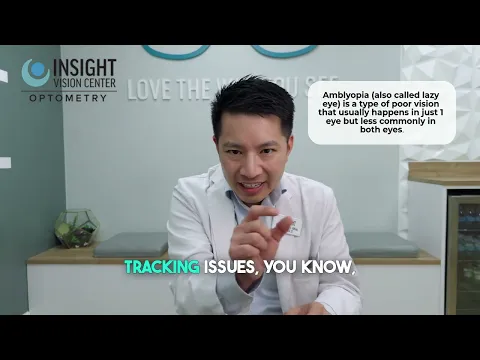
Amblyopia occurs when the brain begins favoring one eye over the other, leading to reduced vision in the weaker eye even after any refractive error is corrected with glasses. It typically develops in early childhood and becomes more difficult to treat with age, making early detection essential.
Although the critical window for treatment is early childhood, older children and some teens can still achieve meaningful improvement with appropriate intervention. Ongoing monitoring matters because amblyopia can return.
Strabismus means the two eyes do not point in the same direction at the same time. One eye may turn inward, outward, upward, or downward while the other eye looks straight ahead, and this can be constant or intermittent.
Any eye crossing that is constant, or any crossing that persists beyond 4 months of age in an infant, should be evaluated promptly. Untreated strabismus can lead to amblyopia, loss of depth perception, and difficulty with activities requiring strong eye coordination. A prompt evaluation allows us to begin treatment at the most effective time.
Color vision deficiency, often called color blindness, is usually inherited and affects boys more frequently than girls. Children with this condition have difficulty distinguishing certain colors, most commonly shades of red and green.
There is no cure for inherited color vision deficiency, but identifying it early helps parents and teachers understand why a child may struggle with color-coded learning materials or certain activities. We can suggest practical accommodations and tools that reduce frustration at school and make daily tasks easier.
Some children have clear vision when looking at still objects but struggle when the eyes need to work together for reading, tracking movement, or shifting focus between distances. These functional vision problems can cause a child to skip lines, lose their place, read slowly, or avoid schoolwork without any obvious outward sign of difficulty.

When we identify a vision problem, we work with you to choose the right treatment for your child's age, lifestyle, and specific needs. Most childhood vision conditions can be managed effectively with the right plan and consistent follow-through.
Glasses are the most common and safest way to correct refractive errors in children. Modern frames are lightweight and durable, and they come in a wide range of styles that children find appealing, which helps encourage consistent wear.
We assist you in selecting frames that fit correctly and lenses suited to your child's visual needs and activity level. Polycarbonate lenses are impact-resistant and a good choice for active children. For sports, we recommend polycarbonate sports goggles that meet appropriate safety standards for eye protection. We also prescribe specialized lens designs, including bifocals, prism, or myopia control lenses, when clinically indicated.
Myopia management is a specialized approach aimed at slowing the progression of nearsightedness during the years when children's eyes are still growing. Our team tailors each plan to the child's age, degree of myopia, and lifestyle, and we monitor closely to track the response over time.
Motivated, responsible children as young as 8 or 9 can successfully wear contact lenses. Maturity and hygiene habits matter more than age alone when determining readiness. Contacts can be especially beneficial for sports, peripheral vision, and confidence.
Daily disposable lenses are often the best starting point for younger wearers because they eliminate the need for cleaning solutions and reduce infection risk. We provide thorough training on proper insertion, removal, and care, and we monitor your child's eye health closely throughout lens wear.
Treating lazy eye typically involves encouraging the brain to rely on the weaker eye by reducing the clarity of the stronger eye. We may prescribe an eye patch worn for a set number of hours each day, or we may use atropine drops to temporarily blur the better eye. This approach is known as penalization and is used in selected cases.
Consistent treatment during the early developmental years gives the best chance for meaningful improvement. We monitor closely to avoid weakening the stronger eye, adjust the plan as vision improves, and work with you to create a realistic and manageable routine. Regular follow-up visits are an important part of the process.
Some conditions, including significant strabismus, congenital cataracts, blocked tear ducts, or other structural problems, may require a referral to a specialist for surgical evaluation. Surgery is considered when non-invasive options such as glasses, patching, or other interventions are not sufficient to achieve the needed correction.
We discuss all options, risks, and benefits with you before any referral is made, and we continue to provide co-management and follow-up care after any surgical procedure your child undergoes. Our goal is to remain your family's primary eye care partner throughout the entire process.
A little preparation before the appointment and attentive follow-through at home can make a significant difference in how smoothly the exam goes and how well treatment works. Here is what we recommend at every step.
Talking to your child in age-appropriate terms helps reduce anxiety and builds cooperation. Let them know that the eye doctor will use lights and fun pictures to check how well their eyes work, and reassure them that the tests are painless.
Having key information ready helps our team provide the most accurate and complete care. Bring your insurance card, a list of your child's current medications or supplements, and any previous glasses or written prescriptions from other providers. Note any known medication allergies.
We also benefit from knowing about any family history of eye disease, developmental concerns, or specific symptoms you have noticed. For infants, birth history details such as prematurity or NICU care are helpful. If your child's teacher has raised concerns about reading, focus, or classroom performance, sharing that context helps us understand their visual needs more fully.
After the exam, we clearly explain what we found and what it means for your child's vision and development. If glasses or another treatment is recommended, we take time to discuss why it matters and what outcomes you can reasonably expect.
A prescription includes numbers that describe the type and degree of refractive error in each eye. We walk you through what those measurements mean in plain terms and help you feel confident about every decision, from lens selection to treatment planning.
Your observations between appointments are genuinely valuable to us. Once treatment begins, noticing how your child responds helps us refine the plan at follow-up visits.
The frequency of follow-up visits depends on your child's specific condition and treatment plan. Children in active amblyopia treatment may need rechecks every few weeks, while those with stable prescriptions and no identified problems may return annually or every two years.
We provide individualized recommendations at every visit. Even when things appear to be going well, ongoing exams remain important because children's eyes change as they grow, and some conditions develop gradually without producing obvious symptoms until they are well established.
Here are answers to questions families frequently bring to us about pediatric eye care, covering practical decisions and situations that may come up between appointments.
School screenings are a helpful starting point but they are limited in scope, typically checking only distance clarity in each eye under controlled conditions. They routinely miss farsightedness, eye teaming problems, focusing difficulties, and early signs of eye disease that can still significantly affect a child's learning. A comprehensive exam with our team evaluates the full range of visual skills and eye health in a way that a brief screening simply cannot match.
Infants cannot describe what they see, and several vision-threatening conditions can be present without producing obvious behavioral signs. Conditions like amblyopia, significant refractive errors, and structural eye problems are most treatable when identified before vision has had time to develop unevenly. An early exam provides a baseline and the reassurance that development is on track, which is valuable on its own.
There is no single correct age. Readiness depends more on a child's maturity, sense of responsibility, and ability to follow hygiene instructions than on a specific birthday. Some children are ready at 8 or 9, while others are better suited to wait until their early teens. During your child's appointment, we assess readiness together and provide all the training and guidance needed for a safe start.
Current evidence does not support the idea that screens cause permanent structural damage to the eyes. However, sustained close work on screens is associated with greater risk of myopia progression in children who are already developing nearsightedness. Prolonged near work can also cause temporary eye strain, dry eyes, and disrupted sleep when devices are used close to bedtime. Encouraging regular breaks, outdoor time, and appropriate viewing distances helps reduce these effects.
Treatment timelines vary depending on the severity of the amblyopia, your child's age at diagnosis, and how consistently treatment is followed. Some children show meaningful improvement within a few months, while others require a year or more of monitoring and adjustment. Starting younger generally leads to faster and more complete improvement, but older children can still benefit. We track progress closely and adjust the approach as your child's vision responds, so there is no single answer that applies to every case.
If your child experiences sudden vision loss, a painful or very red eye, a chemical splash to the eye, or an eye injury involving a sharp object, act quickly. For chemical exposures, flush the eye immediately with clean water or saline for at least 15 minutes before doing anything else, then seek emergency care. For other urgent symptoms, contact us right away for same-day guidance. Do not wait to schedule a routine appointment when symptoms suggest something acute.
Our team is here to be a trusted partner in your child's vision health from their very first exam through the teen years and beyond. We combine thorough, evidence-based care with a warm approach that puts children at ease and helps parents feel confident in every decision. We welcome patients of all ages and look forward to helping your child see their world as clearly as possible.


