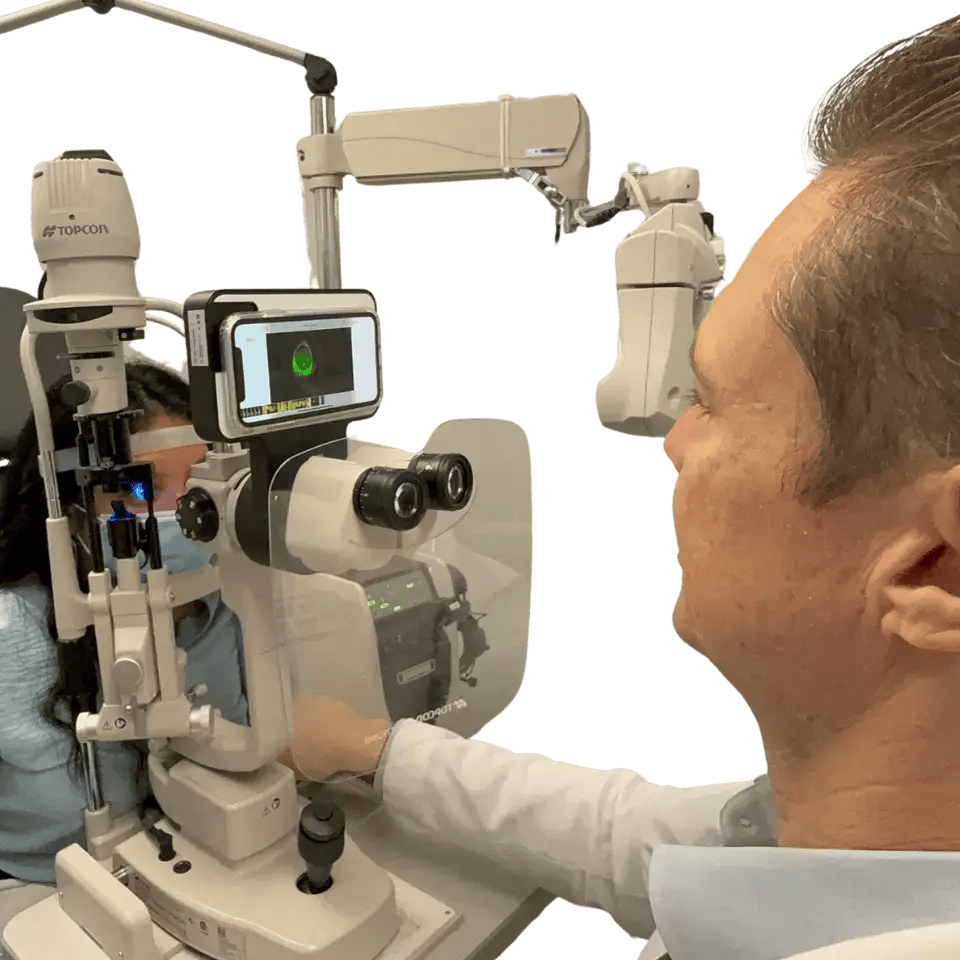
Understanding the difference between managing keratoconus and curing it helps you set realistic expectations and make better decisions about your care. While treatment options have improved dramatically, the corneal changes caused by keratoconus cannot yet be fully reversed. Here is what that means for you in practical terms.
A genuine cure for keratoconus would fully restore your cornea to its original shape, thickness, and structural strength, without the need for ongoing glasses, contact lenses, or monitoring. No treatment available today can accomplish this. Current treatments are highly effective at stopping disease progression and correcting vision, but the underlying changes to your corneal architecture remain.
Stopping keratoconus and reversing it are two very different things. Corneal cross-linking, the most powerful tool we have for controlling the disease, halts progression by strengthening the collagen fibers inside your cornea. Think of it as stabilizing the structure of a building rather than rebuilding it from scratch. After cross-linking, you may still need specialty contact lenses or other vision correction to see clearly, because the existing corneal shape remains.
Keratoconus typically progresses most actively during the teenage years and twenties, then tends to slow or stabilize naturally by the mid-thirties to forties as the cornea stiffens with age. Younger patients generally progress faster and benefit most from early intervention. Even after natural stabilization, lifelong monitoring is important because late progression, while uncommon, can still occur.
While no treatment cures keratoconus, several options work together to protect your cornea and give you the best possible vision. Dr. Woo, Dr. Mai, and Dr. Schramm are all Fellows of the Scleral Lens Society and have extensive experience managing keratoconus at every stage. Dr. Woo is a specialist in specialty contact lenses and keratoconus and offers specialty services such as scleral lenses, EyePrintPRO prosthetic lenses, and dry eye care. Dr. Mai is a specialist in myopia management and scleral lenses and offers specialty services such as Ortho-K, custom scleral lenses for keratoconus, and dry eye care. Dr. Schramm is a specialist in scleral lenses and irregular corneas and offers specialty services such as custom scleral lens fittings for keratoconus and post-LASIK ectasia. The treatments below represent the current standard of care and, for most patients, produce excellent long-term outcomes.
Cross-linking is the closest we have to stopping keratoconus for good. During the procedure, riboflavin (vitamin B2) drops are applied to the cornea, which is then exposed to controlled ultraviolet A light. This process strengthens the collagen bonds inside the cornea and significantly slows or halts further thinning and bulging. Cross-linking halts progression in the large majority of treated eyes, and the FDA approved an updated epi-on technique in 2025 that does not require removing the outer corneal layer, making the procedure less invasive than before.
Specialty contact lenses, particularly scleral lenses, are one of the most effective ways to restore clear, functional vision in keratoconus. Scleral lenses vault entirely over the irregular corneal surface and rest on the white part of the eye (the sclera), creating a smooth optical surface filled with a saline reservoir. This design neutralizes the distortion caused by the cone shape. Our practice is nationally recognized for advanced scleral lens fitting, and Dr. Woo leads a team with combined experience managing thousands of specialty contact lens patients.
For many patients, the combination of cross-linking and well-fitted specialty lenses provides stable, comfortable vision for decades.
A minority of keratoconus patients, estimated at up to around 20 percent, eventually reach a stage where contact lenses can no longer provide adequate vision and a corneal transplant becomes necessary. The most common procedure is a penetrating keratoplasty (PK), in which the central cornea is replaced with donor tissue. Transplant can restore functional vision significantly, though many patients still require glasses or specialty lenses afterward. Graft survival rates are strong in the first decade but may decline over longer periods, which is why monitoring continues even after transplant surgery.
Keratoconus research is advancing more rapidly than at any previous point, and several promising therapies are currently in development. While none of these are yet approved or widely available, they represent a meaningful step toward treatments that address the underlying causes of the disease rather than just managing its effects. Our doctors stay current with emerging research so we can guide you as options evolve.
One of the most closely watched investigational treatments is IVMED-80, an eye drop therapy currently in Phase III FDA clinical trials. It targets lysyl oxidase, an enzyme involved in collagen cross-linking that researchers believe is less active in keratoconus corneas. If approved, this drop could offer a non-invasive way to slow or stop disease progression without UV light exposure or a clinical procedure. Results from ongoing trials will determine whether this becomes a viable first-line treatment option.
Researchers are also exploring the use of stem cells derived from a patient's own fat tissue, known as autologous adipose-derived stem cells, for corneal regeneration. Early human studies have shown that these cells can produce new collagen, increase corneal thickness, and improve vision without significant complications. This approach aims to rebuild damaged corneal tissue rather than simply preventing further loss. Larger clinical trials are still needed before stem cell therapy becomes part of routine keratoconus care.
These developing therapies are genuinely encouraging, but they are not yet approved treatments, and no responsible provider can offer them outside of formal clinical trials. The most important thing you can do right now is protect the vision you have through proven, established care. If you are interested in clinical trial eligibility, your doctor can help you explore whether any active studies are a good fit for your situation.

A keratoconus diagnosis does not mean a lifetime of poor vision. With the right combination of treatments and monitoring, the vast majority of patients maintain stable, functional vision and live full, active lives. The key is building a consistent management plan with a team experienced in corneal disease and specialty contact lenses. Here is what that looks like in practice.
Effective keratoconus management involves regular corneal imaging, updated vision correction as needed, and avoiding eye rubbing, which is one of the most significant risk factors for accelerating progression. Your doctor tailors your plan to your specific stage of disease, age, and rate of change. Annual or semi-annual appointments, depending on how active your keratoconus is, allow your care team to catch shifts before they affect your daily vision.
Your doctor designs a routine that fits your lifestyle while keeping your vision protected over the long term.
Certain changes in your vision should prompt a same-day call to your eye doctor rather than waiting for a scheduled appointment. Sudden increase in blurriness or distortion, vision that your current lenses can no longer correct, significant eye pain, or a sudden clouding of vision may signal acute hydrops, a serious complication in which fluid enters the cornea through a small break. Acute hydrops requires prompt attention to manage properly and minimize permanent scarring. Do not delay care if these symptoms appear.
Keratoconus research is moving faster than ever, and new treatment approvals and clinical trial opportunities continue to emerge. At each visit, ask your doctor whether anything has changed in the treatment landscape that could benefit your care plan. Organizations like the National Keratoconus Foundation also provide patient-friendly updates on new developments. Staying engaged with your care team is the best way to be ready when new options become available.
These questions address specific decisions and scenarios that patients often wonder about when learning that keratoconus does not yet have a cure.
There is genuine reason for optimism. Stem cell therapies aimed at rebuilding corneal tissue and collagen-stimulating eye drops are both in active human trials. A true cure that fully restores the original cornea may become possible in the coming decades, though no reliable timeline exists. For now, proven treatments like cross-linking and scleral lenses already give most patients stable vision for life, so waiting for a future cure is rarely in your best interest.
This is one of the most important questions to discuss with your doctor, and the answer for most patients is no. Every month of untreated progression causes permanent structural change to your cornea that cannot be undone later. Cross-linking preserves the corneal shape you have right now, and importantly, it does not limit your eligibility for future treatments. Your current rate of progression and corneal measurements will guide the timing conversation with your doctor.
A small percentage of patients do experience renewed progression after cross-linking, most often in younger patients with faster-progressing disease. This is why post-procedure monitoring with regular corneal imaging continues for years after treatment. If your doctor detects renewed progression, options include repeat cross-linking or adjustments to your vision correction plan. Early detection through consistent follow-up is essential to staying ahead of any recurrence.
It can. Keratoconus often slows and eventually stabilizes naturally in the mid-thirties to forties as the cornea stiffens with age, a process called age-related cross-linking. However, your doctor cannot predict when this will happen for you personally, or how much vision you may lose before it does. Cross-linking offers a reliable, proven way to stop progression on your schedule rather than waiting for natural stabilization that may arrive too late to protect your vision.
Eligibility for clinical trials depends on factors like your age, stage of disease, progression rate, and whether you have had prior treatments such as cross-linking. Your doctor can review your records and help you determine whether any active trials are a reasonable fit. Trials are typically conducted at academic medical centers or specialty clinics, and your doctor can help coordinate a referral if appropriate. Participating in a trial does not mean giving up access to standard care.
Many patients do. A corneal transplant can dramatically improve the structural health and shape of the cornea, but it rarely eliminates the need for vision correction entirely. Glasses, soft lenses, or specialty contact lenses are often still needed after transplant to achieve the sharpest possible vision. Dr. Woo and Dr. Schramm have extensive experience fitting specialty lenses on post-transplant corneas, which often have their own unique irregularities that require a customized fitting approach.
At Insight Vision Optometry, Las Vegas, our fellowship-trained doctors bring national and international expertise in keratoconus management directly to your care. Whether you are newly diagnosed, managing the disease long-term, or exploring advanced options like cross-linking or custom scleral lenses, our team has the technology and experience to build the right plan for you. We invite you to schedule a consultation and take an active role in protecting your vision for the long term.


