
Corneal arcus forms when fatty deposits, mostly cholesterol and related lipids, build up in the outer layer of the cornea over time. The ring typically appears most visible at the top and bottom of the iris, the colored part of the eye, before slowly completing a full circle. It does not affect vision and is not a sign that the cornea is breaking down.
The ring appears as a hazy arc or complete circle near the edge of the cornea. It is usually white or gray, though it can appear slightly yellowish depending on the person. A thin, clear gap almost always remains between the ring and the very edge of the cornea, which helps distinguish it from other conditions.
Small blood vessels at the outer rim of the cornea can allow fats from the bloodstream to slowly leak into the surrounding corneal tissue. Because the cornea has no blood vessels of its own through its central portion, these deposited fats stay in place once they settle. The buildup is gradual and takes place over years or even decades.
In adults over fifty, corneal arcus is a very common and expected finding. It is considered a normal part of aging in this age group, much like gray hair. The ring grows slowly and rarely requires any specific treatment. Its presence alone is not a sign of disease when it appears in older patients.
In adults under forty, corneal arcus is less typical and deserves closer attention. When arcus appears at a younger age, it can signal elevated blood cholesterol or an underlying lipid disorder. A referral to a primary care provider for a blood lipid panel is often the right next step. Identifying and addressing high cholesterol early offers important benefits for long-term heart health.
Corneal arcus in a child is rare and should always be taken seriously. It may indicate familial hypercholesterolemia, a genetic condition that causes extremely high cholesterol from birth. Any child found to have an arcus ring needs prompt evaluation by a lipid specialist. Early diagnosis and treatment can help prevent serious cardiovascular complications later in life.
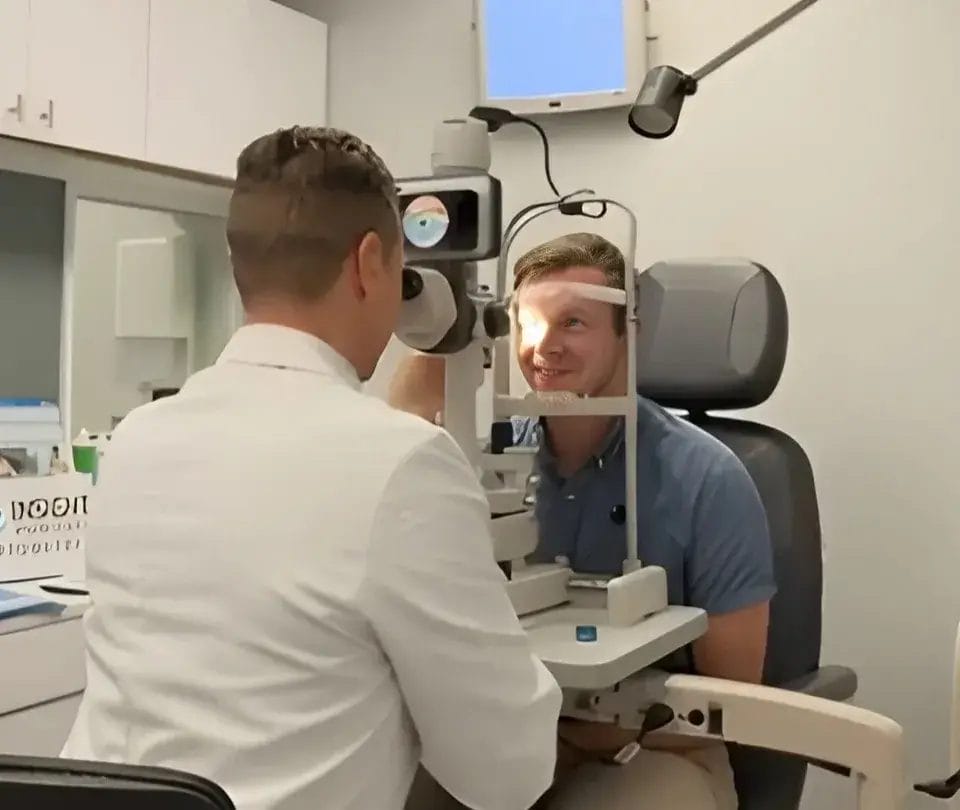
Arcus is typically identified during a comprehensive eye exam using a slit lamp, a specialized instrument that directs a precise beam of light into the eye for detailed examination of the cornea and surrounding structures. Our doctors document the appearance, note any asymmetry between the two eyes, and track changes over time. The diagnosis is usually straightforward, but distinguishing arcus from other rings at the corneal edge requires careful evaluation.
During a slit lamp exam, the ring appears as a whitish or gray arc near the outer edge of the cornea. Our doctors note its location, how complete the arc is, and whether a clear gap exists between the ring and the corneal margin. This gap is a defining feature of true corneal arcus and helps rule out other causes.
Not every ring at the corneal edge is arcus. A copper-colored ring, known as a Kayser-Fleischer ring, can point to Wilson disease, a rare condition involving copper buildup in the body. A grayish ring from silver exposure and inflamed rings from immune conditions can also appear similarly. The color, texture, and clinical history all guide our doctors to the correct diagnosis.
If arcus appears in a patient under forty, our team will typically recommend a fasting lipid panel. This blood test measures LDL cholesterol, HDL cholesterol, and triglyceride levels and is usually ordered through your primary care provider. If the results show elevated cholesterol, a care plan can be put in place to protect cardiovascular health.
In rare cases, arcus appears alongside other signs that suggest a more serious lipid disorder. Yellow fatty deposits on the skin, called xanthomas, or a strong family history of early heart disease in close relatives can be important clues. In these situations, genetic testing and specialist evaluation by a lipid specialist may be appropriate.

The significance of corneal arcus depends largely on the patient's age. In older adults, it is almost always a harmless finding. In younger adults and children, it can serve as an early window into cardiovascular risk. Understanding this distinction helps our patients make informed decisions about their overall health.
For most patients over fifty, arcus is noted in the chart and monitored at future visits. No specific treatment for the arcus itself is needed. Our doctors will continue checking for other age-related eye changes at each visit, but the ring alone does not call for extra testing in this age group.
In adults under forty, arcus may be one of the first visible signs that cholesterol levels are higher than they should be. High cholesterol over time raises the risk of heart attack and stroke. Treating elevated cholesterol with diet changes, exercise, and sometimes medication can meaningfully reduce cardiovascular risk, even if the corneal ring itself does not disappear.
Corneal arcus does not directly damage the eye or affect vision. However, elevated cholesterol affects blood vessels throughout the body, including the small vessels inside the eye. Patients with high cholesterol may have a somewhat higher risk of certain retinal blood vessel conditions. This is one more reason to manage cholesterol when it is elevated.
Arcus itself requires no treatment, but the underlying conditions it may point to can often be addressed effectively. Whether you need only routine monitoring or a more active care plan depends on your age, cholesterol levels, and family history. Our team helps you understand what comes next and works alongside your primary care provider when appropriate.
For older adults, the most important step is continuing regular comprehensive eye exams. Our doctors track any changes in the arcus and look for other signs of age-related eye conditions at each visit. No special treatment for the arcus itself is required, and most patients go on to live healthy lives without any vision impact from the ring.
If arcus leads to a high cholesterol diagnosis, a care plan typically includes diet changes, regular physical activity, and sometimes statin medication. Your primary care provider will manage this plan and order follow-up blood work to track your progress. Importantly, even when cholesterol levels improve, the ring in the cornea usually remains, because the deposited fats do not reabsorb once settled.
Lifestyle changes that support heart health can help slow future arcus growth and protect your cardiovascular system. These habits are beneficial for all adults, regardless of arcus or cholesterol status.
These steps support the whole body and can help reduce the pace at which arcus develops over time.
Corneal arcus often acts as a bridge between eye care and general health care. If our team identifies arcus in a younger patient, we may provide a summary or recommendation that you can share with your primary care provider. This kind of coordinated communication helps ensure that an important finding in the eye does not go unaddressed in the rest of your healthcare.
Corneal arcus itself produces no symptoms. Patients do not feel it, and it does not affect how clearly or comfortably they see. Because it is silent, most people first learn about it at a routine eye exam. That said, there are other symptoms that warrant prompt attention, even in patients who know they have arcus.
The ring forms slowly and does not interfere with the central cornea, which is the area responsible for clear central vision used for reading and driving. It causes no pain, redness, or visual disturbance. Patients sometimes notice the ring in photos or the mirror before their eye doctor mentions it, but it causes no physical symptoms at any stage.
Even patients with known corneal arcus should act quickly on certain eye symptoms that are unrelated to the ring but require same-day evaluation. These include sudden changes in vision, a painful red eye, new or dramatically increased floaters, or flashing lights in the visual field. None of these symptoms come from arcus, but they can indicate other conditions that need urgent care.
Some visible signs outside the eye may suggest elevated cholesterol and are worth discussing with a primary care provider. These include small yellowish deposits near the eyelids, fatty bumps on the elbows, knees, or Achilles tendon, or a family history of heart attack or stroke before age fifty-five in male relatives or sixty-five in female relatives. Mentioning these findings to your doctors supports a more complete health picture.
Patients often have questions after hearing about corneal arcus for the first time. Here are answers to some of the most common ones, with guidance on what to do next.
Corneal arcus does not affect vision at any stage. The deposits form near the outer edge of the cornea and stay well away from the central optical zone used for reading, driving, and detailed tasks. Arcus is never a direct cause of vision loss or blindness. Routine annual eye exams are sufficient for monitoring it in most patients.
Arcus tends to grow very slowly over decades, and the pace is influenced by cholesterol levels and age. When cholesterol is managed well, the growth often slows. However, the ring that is already present does not disappear, even with excellent cholesterol control. Your doctor will track any changes at regular visits, and unusually rapid growth should be brought to the attention of your primary care provider.
There is no safe procedure to remove corneal arcus. Any surgical attempt to clear the ring would place the healthy central cornea at risk for purely cosmetic reasons, which is not advisable. Since arcus does not impair vision or cause discomfort, the appropriate approach is to leave the ring in place and focus on managing any underlying cholesterol issue. Colored contact lenses are not a safe or recommended solution for cosmetic concerns related to arcus.
Small differences in how arcus appears between the two eyes are common and usually not a concern. A significant asymmetry, where one eye shows a pronounced ring and the other shows very little, is less typical and warrants closer evaluation. Our doctors will note any asymmetry during your exam and determine whether additional testing is appropriate based on your overall clinical picture.
For adults over fifty, arcus alone does not automatically call for a cholesterol test, since it is considered a normal aging finding in this group. That said, if you have not had your cholesterol checked recently, or if you have other cardiovascular risk factors, a lipid panel through your primary care provider is still a reasonable step. Age alone does not eliminate the benefit of knowing your cholesterol numbers, and your eye exam findings can be a useful prompt for that conversation.
Corneal arcus in a child is uncommon and always requires immediate follow-up. It is most often associated with familial hypercholesterolemia, a genetic condition that leads to very high cholesterol from birth and significantly elevated cardiovascular risk. A referral to a pediatric lipid specialist should happen without delay. Early treatment can prevent serious heart disease and significantly improve long-term health outcomes for the child.
If you or a family member has been told about a ring around the iris, our team at Insight Vision Optometry, Las Vegas is ready to help you understand what it means and whether any next steps are needed. We provide thorough eye exams, careful documentation of findings like corneal arcus, and clear guidance on when to involve other healthcare providers. Our goal is to support not just your eye health, but your overall wellbeing, and we look forward to seeing you in our Las Vegas office.


