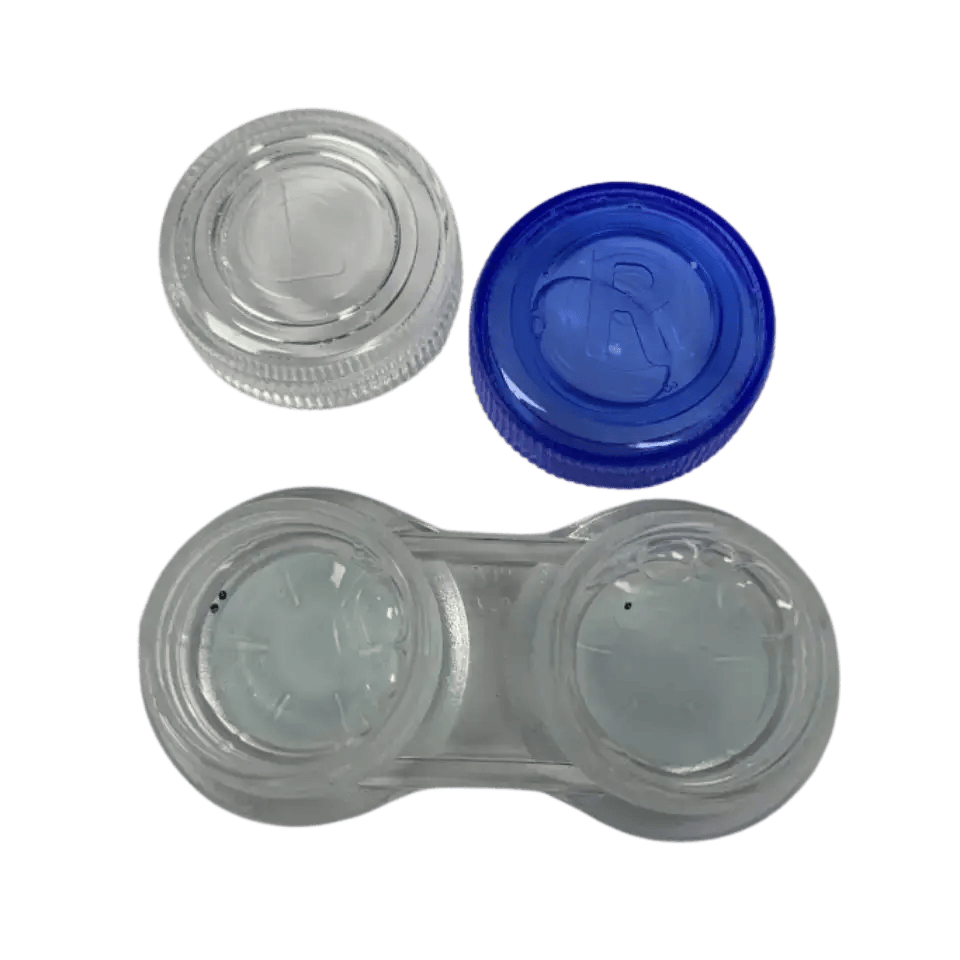
A glasses prescription and a contact lens prescription both correct your vision, but they are built on different measurements and serve different purposes. Understanding the distinction helps you make smarter decisions about your eye care and avoid common ordering mistakes.
Federal rules require a contact lens prescription to include several pieces of information that a glasses prescription simply does not contain. This includes the brand name, base curve, diameter, corrective power, and an expiration date, along with cylinder and axis values for astigmatism correction and add power for multifocal designs. A glasses prescription only addresses how much correction your eye needs, not how a physical lens should fit on your eye. Our doctors can only release a contact lens prescription after a fitting confirms a safe and comfortable fit on your specific eye.
Glasses sit roughly 12 millimeters in front of the cornea (the clear front surface of the eye). Contact lenses sit directly on the tear film covering the cornea. Because of this difference in distance, a concept called vertex distance, the power required to correct the same vision problem changes between the two formats. This difference becomes clinically meaningful when a prescription reaches plus or minus 4.00 diopters or stronger. A simple online chart cannot substitute for a proper fitting, but understanding this concept explains why the numbers on the two prescriptions often do not match.
For myopia (nearsightedness), the contact lens power is usually a smaller minus number than the glasses power. For hyperopia (farsightedness), the contact power is usually a slightly larger plus number. Mild prescriptions sometimes round to the same value in both formats. Stronger prescriptions tend to diverge by half a step or more. Our doctors manage this conversion, verify it with a trial lens, and fine-tune the result during your fitting visit.
Every contact lens prescription includes fit parameters that have nothing to do with a glasses prescription. The base curve, measured in millimeters, describes the back curvature of the lens and must closely match the curvature of your cornea. A lens with a base curve that is too flat will rock with each blink. A base curve that is too steep traps debris and reduces tear exchange beneath the lens. The diameter controls how far the lens extends across the eye. These parameters are not optional preferences. They are structural measurements that determine whether a lens is safe to wear for hours at a time.
A contact lens fitting is a separate service from a standard eye exam and includes its own measurements and evaluation steps. Each step exists to confirm that the lens we select is healthy and functional for your specific eyes.
Our doctors begin by measuring the curvature of your cornea using a technique called keratometry. These measurements guide the base curve selection for your lens. We also evaluate your tear film quality, because a dry eye handles contact lens wear very differently than a well-hydrated eye. If your tear film is poor, we may recommend treating the dryness first before moving forward with the contact lens fitting to protect your long-term comfort and corneal health.
After measurements, we place a diagnostic trial lens on the eye and observe how it behaves in real time. We check how the lens centers on the cornea, how far it moves with each blink, and how it settles over a short observation period. A final prescription is only released after this on-eye evaluation confirms a safe and stable result. A lens that appears correct based on measurements alone can still sit too tightly, ride too high, or drift off-center on a real eye. The trial lens step is where those problems are caught and corrected.
Toric contact lenses are designed to correct astigmatism, a condition where the cornea is shaped more like a football than a sphere, causing blurred vision at multiple distances. These lenses carry cylinder and axis values similar to a glasses prescription, but they must also stay at the correct rotational position on the eye. If a toric lens rotates unpredictably, we may switch to a different brand or recommend a rigid gas-permeable lens rather than copying the glasses cylinder and axis directly. This is one of the most common reasons the astigmatism numbers on a glasses prescription and a contact lens prescription look different.
Each contact lens brand has its own base curve, diameter, and lens material. A prescription written for one brand does not automatically apply to another, even at the same corrective power. Federal law does not permit brand substitution without the prescribing doctor's authorization. This is why online retailers require the exact brand listed on your prescription. A lens that fits comfortably from one manufacturer may create fit problems when substituted with another, even if the power looks identical on paper.
Wearing contact lenses safely depends on following a few important rules about prescriptions, timing, and symptoms. Knowing these guidelines helps protect your corneal health and keeps your vision clear year-round.
Some patients use online vertex-distance charts to try to convert their glasses prescription into a contact lens prescription on their own. The FDA is clear that dispensing contact lenses without a proper fitting violates federal regulation and puts the eye at risk of corneal injury. An online chart cannot measure your base curve, assess your tear film, or check whether a lens centers properly on your eye. The math is only one small piece of a fitting, and it cannot replace an in-person evaluation.
Prescription expiration is determined by state law. When no state rule applies, federal law sets a default one-year expiration unless your doctor documents a medical reason to shorten the interval. We recommend scheduling your renewal visit about a month before your prescription expires so you do not run out of lenses. Sellers are not legally permitted to fill an expired contact lens prescription, so staying ahead of the expiration date avoids unnecessary gaps in your lens supply.
Most contact lens discomfort is minor and resolves after removing the lens. However, certain symptoms require a same-day evaluation. Remove your lenses immediately and contact us if you notice any of the following.
These signs can indicate an infection, a corneal abrasion, or a serious fit problem. Switch to glasses, and bring both the lens and the solution bottle to your visit so our doctors can assess the situation fully.
Prescriptions shift as the eye changes over time, and comfort often declines gradually, making small problems easy to miss. If your lenses start to feel heavy or uncomfortable by midday, if your vision feels slightly less sharp than it used to, or if you notice burning that was not there before, do not wait for your annual renewal. These are signs that a fitting visit may be needed sooner. Addressing changes early protects your eye health and restores your comfort before a small issue becomes a bigger one.

These questions address common points of confusion that come up when patients are comparing their glasses and contact lens prescriptions or preparing for a fitting visit.
This comes down to vertex distance, the gap between the lens and the cornea. Because glasses sit farther from the eye than contact lenses, they require a slightly stronger correction to achieve the same result. For most nearsighted patients, this means the contact lens number will be a smaller minus value than the glasses number. The difference grows with prescription strength. Our doctors calculate the exact conversion and verify it on your eye with a trial lens before finalizing the prescription.
A vertex calculator can provide a rough starting estimate for the corrective sphere, but that is where its usefulness ends. It cannot determine your base curve, diameter, or the right brand for your eye shape. It also cannot account for astigmatism differences that often appear in contact lens form. Think of it as a curiosity tool, not a clinical one. A proper fitting is the only way to arrive at a contact lens prescription that is both accurate and safe.
Toric lenses must stay at a precise rotational angle on the eye to correct astigmatism properly. If the lens settles at a slightly different angle than expected, our doctors adjust the cylinder and axis values to match how the lens actually sits on your eye during the fitting. This means the numbers rarely transfer directly from a glasses prescription. The final contact lens values reflect both the degree of astigmatism and the real-world behavior of the lens on your specific eye.
No. A comprehensive eye exam covers your overall eye health and produces a glasses prescription, but a contact lens fitting is a separate visit with its own measurements and fee. If you want to wear contacts or switch lens types, let us know when you schedule so we can set aside time for the fitting component. First-time contact lens patients and those switching to a new lens category such as toric or multifocal should expect the fitting step to take additional time.
A small change in your glasses prescription does not always require an immediate contact lens refit, especially if the shift is minor and your current lenses still feel stable and clear. A more significant change, or one that involves a new astigmatism component, usually calls for a refit visit. Bringing both your updated glasses prescription and your current contact lenses to the visit helps our doctors compare the values and determine whether a new contact prescription is needed.
Ordering contacts online is legal and convenient as long as you have a current, valid prescription for the exact brand, power, base curve, and diameter listed. Retailers are required by law to verify your prescription before dispensing lenses. Problems arise when patients order under an expired prescription, swap brands without a new fitting, or rely on a glasses prescription instead of a contact lens prescription. If anything about your current prescription is uncertain, visit us for a fitting before placing an online order.
A contact lens fitting is the only safe and accurate way to turn your vision correction into a prescription that truly works on your eyes. Our team brings deep expertise in contact lens care and is here to guide you through every step, from your first trial lens to your final prescription. We welcome patients from across Las Vegas and beyond, and we make it easy to book online or request same-day availability. Visit us and let us fit you with lenses that are comfortable, clear, and right for your eyes.


