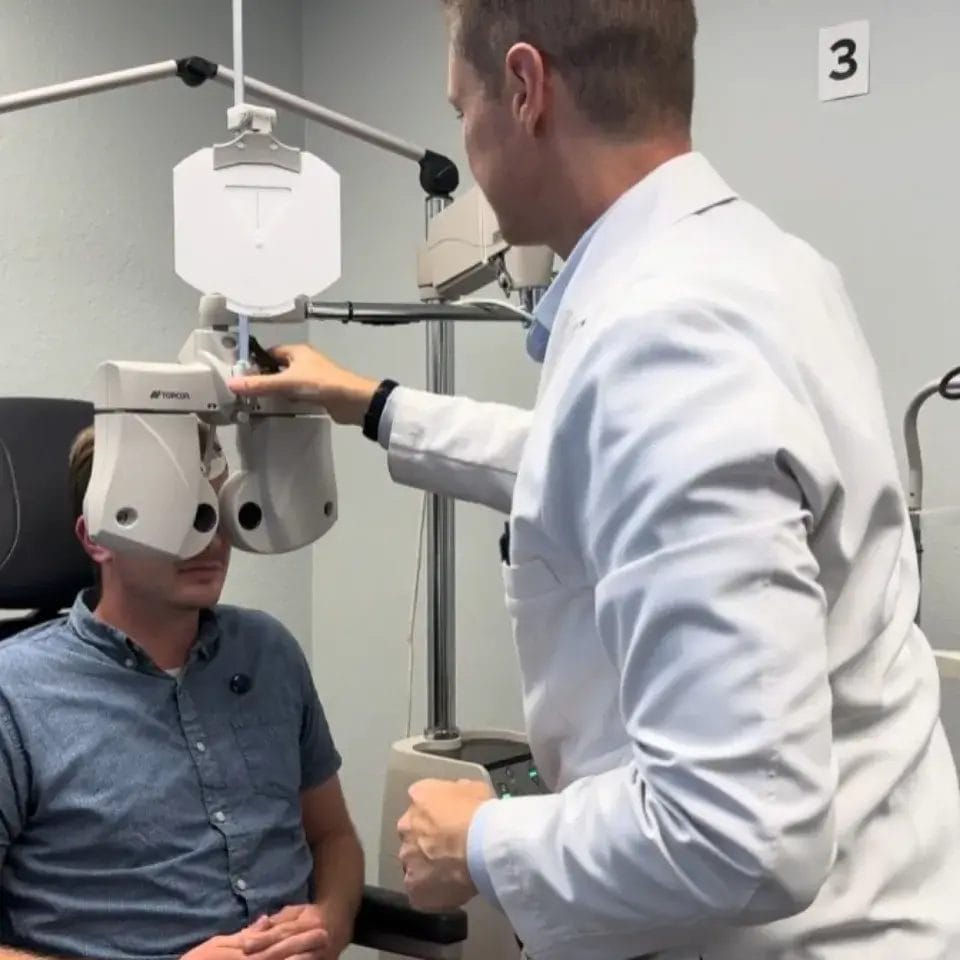
The human eye is remarkably good at compensating for small visual errors, but that compensation comes at a cost. When your glasses are not quite right, your eyes work harder than they should, and that extra effort adds up over the course of a day.
Inside your eye is a focusing muscle called the ciliary muscle. It works with the natural lens to shift focus between near and far distances. When your prescription is off, that muscle is forced to either over-focus or fight against a lens power that does not match your vision needs. Hours of this kind of strain lead directly to fatigue, blur, and head pain.
Asthenopia is the medical term for eye strain. It describes a cluster of symptoms that includes tired or aching eyes, headache, blurry vision, light sensitivity, and difficulty keeping the eyes comfortably open. These symptoms are a well-recognized response to wearing the wrong refractive correction. Patients often notice they feel worst late in the day or after long periods of reading or screen use.
Wearing an incorrect prescription as an adult does not cause long-term structural damage to your eyes. The symptoms are real and uncomfortable, but the eye does not weaken or change in a harmful way from using a mildly off prescription. The discomfort is your body's signal that something needs adjusting, not a sign of injury.
The symptoms tied to an incorrect prescription tend to follow recognizable patterns. Knowing what to look for can help you decide whether what you are experiencing is a normal adjustment or a sign that something needs to be rechecked.
Blurriness is the most direct sign of a prescription problem. It may happen at distance, up close, or both. Some people notice that squinting briefly sharpens the image. Squinting creates a pinhole effect that reduces blur, and if that trick works for you, it is a strong clue that your lens power is not quite right. Blurriness that does not improve with a blink or a short break is worth having evaluated.
Prescription-related headaches usually settle in the front of the head or behind the eyes. They tend to build gradually over hours of wear and often ease after you remove your glasses and rest your eyes. A dull, persistent brow ache is a particularly common sign of uncorrected astigmatism or a cylinder axis that is even slightly off. People with higher astigmatism corrections are especially sensitive to these small errors.
Eye strain from a wrong prescription feels like a heavy, aching, or pulling sensation in the eyes, even when the rest of your body feels fine. It is typically worst during close-up tasks like reading or working on a screen. Taking breaks may give some relief, but if the strain returns the moment you put your glasses back on, the prescription is likely the source rather than the activity itself.
A significantly incorrect prescription, especially one with a big power change or a new prism component, can sometimes trigger nausea or a swimming sensation. This is particularly common with progressive lenses when the reading corridor is not positioned correctly for your eyes. Light sensitivity often accompanies these symptoms. Walking into a bright environment in glasses that do not feel right can quickly bring these feelings on.

Prescription errors can arise from the exam itself, from the lab that makes the lenses, or from how the frame is fitted to your face. In many cases, a simple adjustment resolves the problem without changing the prescription at all.
Overcorrection means too much minus or plus power was prescribed. Your eye's focusing system then has to work against that extra power, leading to fatigue, headaches, and intermittent blur. Some patients feel sharper than normal at first with an overcorrected lens and assume the stronger prescription must be right, but the strain usually catches up with them within a few days of regular wear.
A prescription for astigmatism has three components: sphere power, cylinder power, and axis. Even a few degrees of error in the axis can cause a tilted or distorted quality to vision and significant eye fatigue. A cylinder that is too strong or too weak creates its own strain. People with moderate to high astigmatism feel these small errors most acutely and may need a very precise fit to be comfortable.
Pupillary distance, often called PD, is the measurement from the center of one pupil to the center of the other. The optical center of each lens needs to align precisely with your pupils. When the PD measurement is off, even by just a few millimeters, the lenses create an unintended prism effect. This can cause a feeling of being pulled to one side, mild double vision, or a persistent headache, even when the actual power of the prescription is correct.
Vision changes gradually over time, and a prescription that felt perfect two years ago may no longer match your current needs. Adults in their 40s and 50s often experience a steady increase in their near add strength as presbyopia, the natural age-related loss of close focusing ability, progresses. Using an older pair of glasses regularly can cause the same symptoms as wearing an outright incorrect prescription. If it has been more than a year or two since your last exam, an updated prescription is a smart first step.

Not every uncomfortable feeling with a new pair of glasses means something is wrong. Some degree of adjustment is normal, especially after a prescription change. Knowing the expected timeline helps you judge whether to wait or reach out to us.
A modest prescription change commonly causes mild strain, occasional blur, or a sense that things look slightly distorted during the first week of wear. Your brain takes time to recalibrate to the new image your glasses are providing. Floors may look slightly tilted. Straight edges may appear slightly curved. These early adaptation symptoms are expected and usually resolve on their own as your visual system adjusts.
Two weeks is the general guideline most eye care professionals use as the outer limit for normal adaptation. Symptoms that are still present and not clearly fading after two weeks of regular wear deserve a recheck. The issue is usually a small tweak to the prescription, a PD correction, or a frame adjustment. There is no benefit to pushing through discomfort that is not improving on its own.
First-time wearers of progressive lenses, which contain zones for distance, intermediate, and near vision in a single lens, often need three to four weeks to fully adapt. Learning to move your head rather than just your eyes to find the right zone takes practice. If a swimming or tilting sensation continues beyond that window, the corridor length, the height of the reading zone, or the frame fit may need adjustment. A visit with our team can usually identify the cause quickly.
Screen use puts particular demands on the visual system, and even a small prescription error can make those demands feel much harder to manage. If most of your eye strain happens at work or in the evening after hours of screen time, the two issues are closely connected.
Computer vision syndrome is the name for the collection of eye and vision problems that result from extended screen use. Symptoms include fatigue, dryness, headache, and blurry vision after long periods at a screen. An incorrect or outdated prescription is one of the most common underlying contributors. When the eyes have to work harder than necessary to maintain focus at a fixed distance for hours, even small errors in the prescription are felt much more strongly.
A practical habit for reducing screen-related strain is the 20-20-20 rule. Every 20 minutes, look at something at least 20 feet away for 20 seconds. This gives your ciliary muscle a brief rest from holding a fixed focus. The rule does not fix a prescription problem, but it reliably reduces the buildup of fatigue throughout a long workday. Pairing it with a correct prescription gives you the best foundation for comfortable screen use.
Blink rate drops significantly during screen use, which dries out the tear film and adds another layer of discomfort on top of any prescription-related strain. Artificial tears can help with this. Good ambient lighting and reducing glare on your screen also matter more than many people realize. A room with heavy glare or poor contrast can mimic the feeling of a wrong prescription. It is worth ruling out these environmental factors before assuming the prescription itself is the problem.
Anyone can experience symptoms from an incorrect prescription, but certain groups are more sensitive to small errors and more likely to notice them quickly.
Patients with high myopia, or nearsightedness, high hyperopia, or moderate to high astigmatism tend to feel even small prescription errors more intensely than patients with mild corrections. The stronger the lens, the greater the impact of a small deviation from the ideal power or axis. If you have a strong prescription and your new glasses do not feel right, do not wait to reach out.
Adults in their mid-40s and beyond have less reserve focusing ability than younger patients. This means that any extra focusing demand created by a slightly off near prescription feels harder to sustain and causes fatigue more quickly. A fresh near add or an updated progressive prescription often resolves the symptoms efficiently.
People whose work or daily routines involve long hours of steady near or intermediate focus, including office workers, students, designers, and coders, are more likely to run into prescription-related strain than people whose visual demands vary throughout the day. These patients sometimes benefit from a dedicated pair of glasses optimized for their specific screen distance rather than a general-purpose prescription.
Children can outgrow a prescription within a year. Unlike adults, children often do not report that their vision is blurry. Instead, parents may notice squinting, eye rubbing, complaints of headaches after school, or a decreasing interest in reading. A current exam is the most reliable way to know whether a child's prescription is still accurate. Early detection and correction are particularly important in young children, where an uncorrected large refractive error can contribute to amblyopia, a condition where the brain does not fully develop normal vision in one eye.
A prescription recheck is a logical first step when you have headaches or eye strain, but it is not the only possibility. Several other common conditions can produce identical symptoms, and sometimes more than one factor is involved at the same time.
Dry eye disease, seasonal eye allergies, and eyelid inflammation known as blepharitis can all produce blurry vision, eye fatigue, and discomfort that closely resembles a prescription problem. A gritty, burning, or sandy feeling in the eyes is more suggestive of a surface issue than a lens error. An eye exam can reliably distinguish between the two in a single visit, and treating the underlying cause brings quick relief.
Dehydration, poor sleep, low humidity, prolonged near work without breaks, and inadequate lighting can all cause or worsen eye strain and headaches. These factors are worth evaluating alongside any prescription recheck. Simple changes like increasing water intake, improving office lighting, and taking regular breaks can make a meaningful difference even before a lens adjustment is made.
Not every headache that occurs during screen use or reading is caused by the eyes at all. Migraines and tension headaches are very common and may coincide with visual tasks simply because of timing. A throbbing one-sided headache, visual aura, nausea, or neck and shoulder tension suggests a cause outside the eyes. If your headaches are severe, frequent, or accompanied by neurological symptoms, pairing an eye exam with a visit to your primary care doctor is the right approach.
These answers address questions our patients ask most often about prescription discomfort and when to take action.
Yes, and the degree of sensitivity varies from person to person. A quarter-diopter difference can feel significant to a patient who uses their eyes intensively at near distances or who works long hours on a screen. For someone with a less visually demanding routine, the same change may go entirely unnoticed. Letting your eye doctor know that you are sensitive to small changes helps guide how the prescription is refined at your next exam.
Even identical power numbers can feel different in a new frame. The pantoscopic tilt (the angle the frame sits on your face), the vertex distance (how far the lens sits from your eye), the wrap angle, and the lens material all influence how the prescription performs in practice. A frame fitting adjustment at the optical can often resolve this without any change to the prescription itself. Ask for a fit check before assuming the numbers are wrong.
During the first week, brief breaks are a reasonable part of adaptation, especially if mild headaches are your only symptom and they ease when you remove the glasses. However, if removing the glasses is the only thing that provides relief and the symptoms return immediately every time you put them back on, that pattern suggests the prescription needs a closer look rather than more adaptation time. Consistent discomfort that does not trend toward improvement is the signal to come back in.
A wrong pupillary distance typically creates a sensation that your eyes are being pulled inward or outward, mild eyestrain even at distance, or a subtle double image that requires effort to fuse into one. The feeling is often subtle with small errors, which makes it easy to dismiss. A quick remeasurement at our office takes only a minute or two and immediately clarifies whether the PD is contributing to your discomfort.
For older children and teenagers, an outdated prescription mainly causes symptoms like headaches and eye strain rather than lasting harm. For younger children, particularly those under age eight, a large uncorrected or undercorrected refractive error over an extended period can interfere with normal visual development and contribute to amblyopia. For this reason, keeping up with annual pediatric eye exams is important, and any concerns flagged at a school vision screening warrant a full exam promptly.
Both factors may be contributing at the same time. Smartphones are typically held at a shorter distance than a book or monitor, which increases the demand on your near focusing system. A prescription that is adequate for computer work may fall slightly short for phone use at a very close range. Additionally, viewing a bright screen in a dim room increases contrast strain. A near prescription recheck, combined with habits like holding your phone farther away and ensuring your room is reasonably lit, addresses both sides of the problem.
If your glasses are causing headaches, eye strain, or persistent blur, you deserve a clear answer and a comfortable solution. Our team combines thorough testing with careful attention to fit and lens accuracy so that your glasses work for you from the first week of wear. We welcome you to schedule a visit and let us find out exactly what your eyes need.


